Cabinet Hinge Buying Guide: Overlay, Mounting & RFQ Checklist
Cabinet hinges that look similar may differ in door overlay, cup or mounting geometry, opening angle, closing action and adjustment range. Start from the cabinet construction.
Compare a 304 soft-close hinge configuration
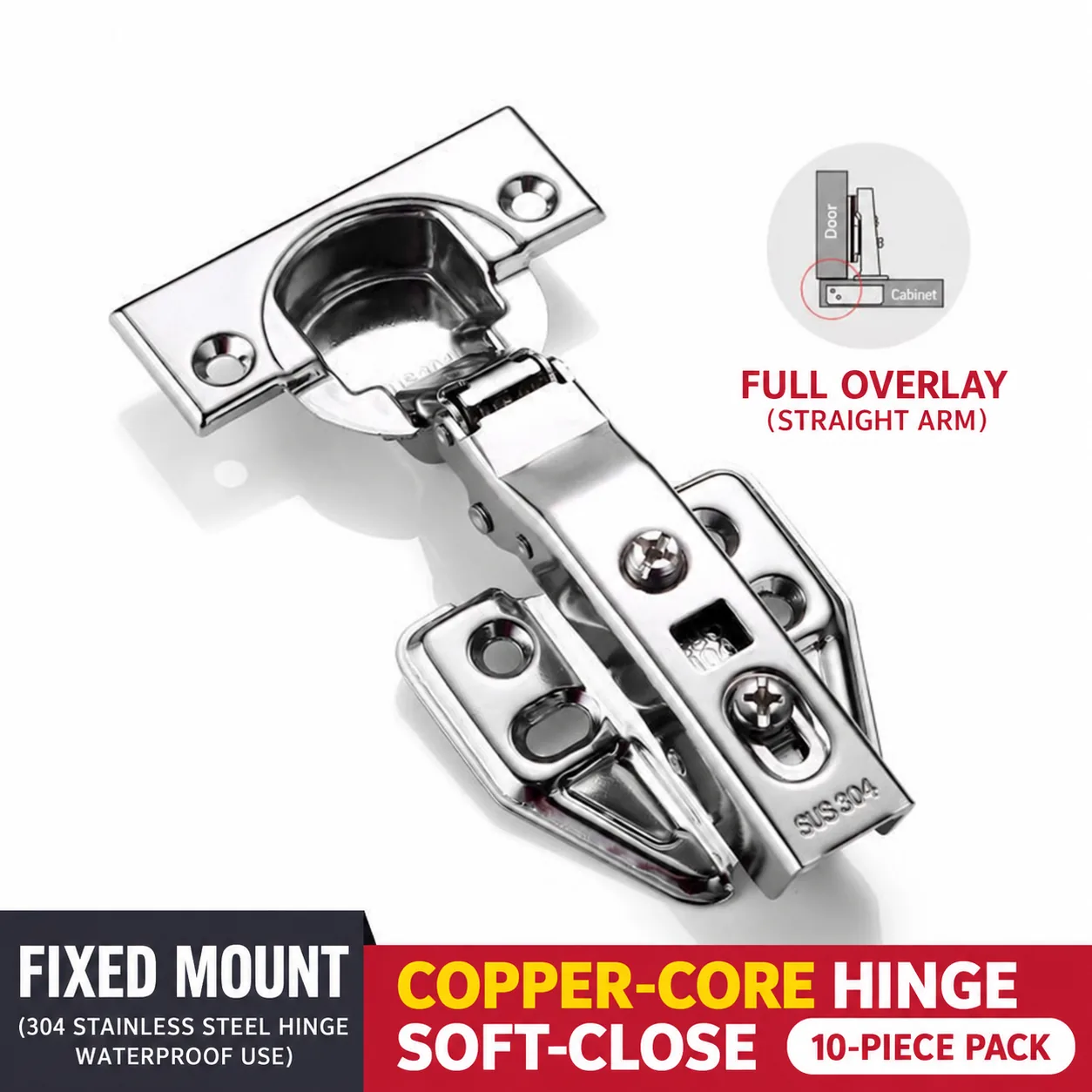
304 Soft-Close Cabinet Hinges — 10-Piece Packs
Compare full overlay, half overlay and inset, with fixed or clip-on mounting. The source specifies 10-piece packs; send your required total hinges and packs.
Watch: cabinet-hinge mechanisms and mounting details → The video illustrates selection points; confirm the drawing and material for the exact SKU you order.
1. Describe the door position
| Door relationship | Typical description | What to send |
|---|---|---|
| Full overlay | The closed door covers most of the cabinet side or divider | Side-panel thickness, required overlay and door thickness |
| Half overlay | Two doors share a centre divider or the door covers part of the panel | Divider thickness, door gap and overlay for each door |
| Inset | The door closes inside the cabinet opening | Opening size, reveal/gap and door thickness |
| Special angle or corner | Corner cabinet, angled panel, folding door or unusual movement | Plan view, opening angle and hinge position drawing |
Terms differ between markets. Include a simple section drawing with dimensions so the supplier can interpret “overlay” the same way you do.
2. Confirm the mounting system
Concealed cup hinges
Confirm cup diameter, cup depth, screw or dowel pattern, mounting-plate type and the distance from the door edge to the boring. If your factory already uses a drilling jig, send its pattern.
No-cup or special concealed hinges
Some hinges use a different mortise, plate or 3D adjustment system. Request the installation drawing and verify the door and frame machining before production.
Surface or non-mortise cabinet hinges
Confirm leaf size, open/closed geometry, screw positions and whether the hinge is handed. Do not treat a door butt hinge and a cabinet hinge as interchangeable only because both have two leaves.
3. Select closing action and opening requirement
- Self-closing: confirm the closing range and door-weight application.
- Soft-close: confirm whether damping is integrated or added separately and whether adjustment is available.
- Free-swing or non-hydraulic: use where the project does not require a self-closing/damped action.
- Push-to-open systems: check hinge compatibility with the selected latch or opening mechanism.
Opening-angle names are approximate unless the selected SKU drawing states the geometry. For adjacent walls, pull-out fittings or thick doors, verify interference with a sample cabinet.
4. Check adjustment and installation space
Ask which directions can be adjusted after installation: side-to-side, height and depth. Also confirm the mounting-plate height, door thickness range and space required for the hinge arm. A hinge may fit the cup hole but still produce the wrong overlay if the arm and plate combination differs.
5. Material, finish and environment
Specify the required base material or grade only when the project needs it, and request evidence for the selected option. Finish names such as nickel colour, black or gold describe appearance, not corrosion performance. State whether the hinge will be used in a dry interior, kitchen, bathroom, coastal or other demanding environment so the quotation can address the right material and coating.
Cabinet-hinge RFQ checklist
| Cabinet | Frameless or face-frame construction; panel thickness |
|---|---|
| Door | Full overlay, half overlay, inset or special angle; door thickness and weight |
| Machining | Cup diameter/depth, boring distance, screw or dowel pattern |
| Movement | Required opening, self-close, soft-close, free-swing or push-to-open compatibility |
| Appearance | Material requirement, finish and visible/hidden installation |
| Commercial | Quantity, packing, screws/mounting plates, destination and sample requirement |
Common buying mistakes
- Choosing by cup diameter while ignoring arm and mounting-plate geometry.
- Using “straight bend” or “full overlay” without a dimensioned cabinet section.
- Assuming every hinge in a family has soft-close.
- Forgetting to confirm whether plates and screws are included.
- Skipping sample-cabinet testing for thick doors or special angles.
Browse and enquire
Compare the cabinet hinge collection, then select the closest SKU and include a door/panel sketch with the enquiry.
Prepare a cabinet-hinge quotation
Send the door position, panel and door thickness, mounting pattern, required action, quantity and destination.