How to Choose Drawer Slides: B2B Specification & RFQ Guide
A drawer slide should be selected from the drawer construction, mounting position, required movement and verified dimensions—not from appearance alone.
Measure first, then choose a size
Use our side-mount drawer-slide measurement checklist to record closed length, cabinet depth, side gaps and mounting holes.
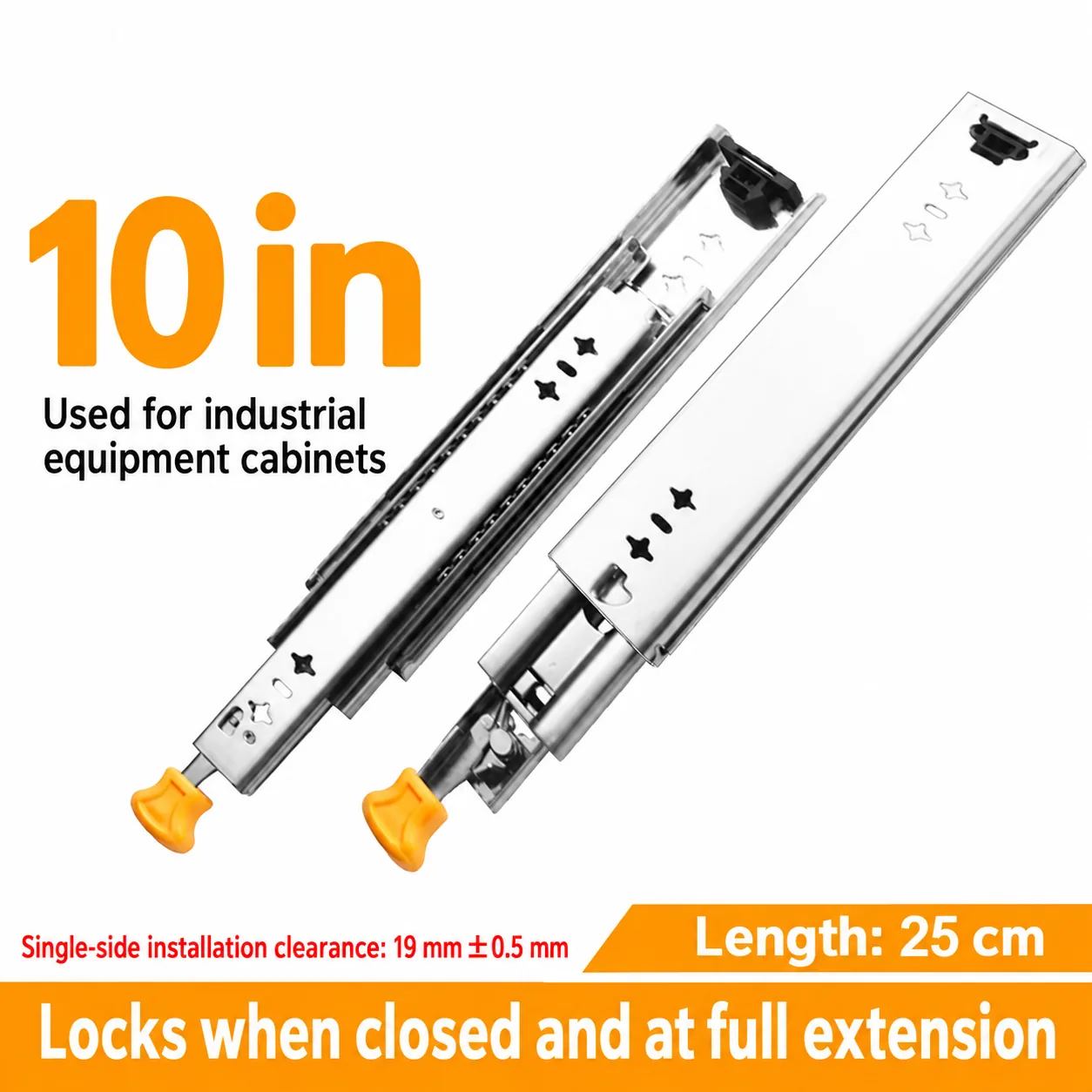
53 mm Heavy-Duty Locking Drawer Slides — 10 to 40 in
16 nominal lengths from 10 to 40 in, with SKU-specific pictures. Confirm the load requirement, pair/piece unit and installation drawing in your RFQ.
Watch: drawer-slide movement and selection details → This short video introduces the product family; it is not an installation test of the linked locking-slide SKU.
1. Identify the mounting position
| Slide family | Where it mounts | What the buyer should confirm |
|---|---|---|
| Side-mount ball-bearing slide | On the drawer sides and cabinet sides | Side clearance, rail width, closed length, extension and hole pattern |
| Undermount or concealed slide | Below the drawer, usually hidden in use | Drawer-bottom construction, rear fixing, locking device and compatible drawer dimensions |
| Heavy-duty slide | Side-mounted in equipment, storage or industrial applications | Required load, installation orientation, extension, lock requirement and test conditions |
| Special movement system | Pocket door, rotating island, retracting table or custom furniture | Movement path, installation drawing, travel, handedness and available space |
If the project drawing is not final, send a cabinet and drawer cross-section. A supplier cannot confirm fit from the outside cabinet width alone.
2. Choose the required movement
Extension
Confirm whether the drawer must open partially, approximately to its full closed length, or beyond it. Supplier terms such as two-section, three-section, full extension and over travel describe different constructions. The exact travel should be checked on the selected drawing rather than inferred from the marketing name.
Closing or opening action
- Standard: no soft-closing or push-to-open function is assumed.
- Soft-close or damped: the selected SKU must show the buffer or damping construction.
- Push-to-open: confirm the compatible drawer weight, opening stroke and installation adjustment.
- Locking: state whether locking is required when open, closed, or in both positions.
Do not apply a family-level feature to every variation. DESLA keeps material and mechanism wording option-specific when the supplier cards differ.
3. Confirm dimensions in a fixed order
- Closed or nominal length: state both millimetres and inches when possible.
- Rail width and overall thickness: needed for cabinet and drawer clearance.
- Extension or travel: do not assume it equals the nominal length.
- Hole pattern: provide a drawing when replacement compatibility matters.
- Pair or piece: confirm the quotation unit and packing unit.
A nominal 18 in description does not by itself confirm the exact closed length, mounting clearance or hole positions. Use the SKU image and final drawing together.
4. State the load requirement correctly
“Heavy duty” is not a complete engineering requirement. Tell the supplier the expected working load per drawer or moving assembly, slide orientation, slide spacing, centre of gravity, cycle expectation and operating environment. A printed supplier load label is a selection reference, not an independent certificate. Ask for the applicable test method and documentation if the project requires verified performance.
5. Material and finish
Common listings may include cold-rolled steel, stainless-looking finishes and options explicitly marked as a stainless grade. Do not assume that a silver appearance proves 304 stainless steel. If corrosion resistance or a particular grade is required, name the grade in the enquiry and request the relevant material documentation for the selected SKU.
Drawer-slide RFQ checklist
| Application | Cabinet, kitchen drawer, tool storage, equipment, pocket door, table or another use |
|---|---|
| Mounting | Side mount, undermount, concealed or special system |
| Movement | Standard, damped, push-to-open, locking; required extension/travel |
| Dimensions | Nominal/closed length, rail width, thickness, clearance and drawing |
| Performance | Working load, orientation, usage frequency and environment |
| Commercial | Quantity per SKU, pair/piece unit, packing, destination and required delivery date |
Common buying mistakes
- Ordering only by nominal length without checking side clearance.
- Treating every silver slide as stainless steel.
- Assuming a standard slide is soft-close because the family contains damped options.
- Using a printed load label without confirming test conditions.
- Sending a cabinet photo without a cross-section or installation dimensions.
Browse and enquire
Review the drawer slide collection. Product pages show the accepted specification labels and available SKU images. For a comparable quotation, add the exact variations and quantities to one enquiry.
Prepare a drawer-slide quotation
Send the application, selected size, required movement, quantity and destination. Attach a drawing when fit or hole compatibility matters.